| Sparked | Centuries of debate among scholars about the nature of randomness, the limits of computation, and the origins of complex systems |
| Proposed by | |
| Continues to | Inspire thought experiments and speculations in a wide range of scientific disciplines |
| Significance | Foundational to the emerging fields of probability theory and information theory |
| Proposed year | 1670s |
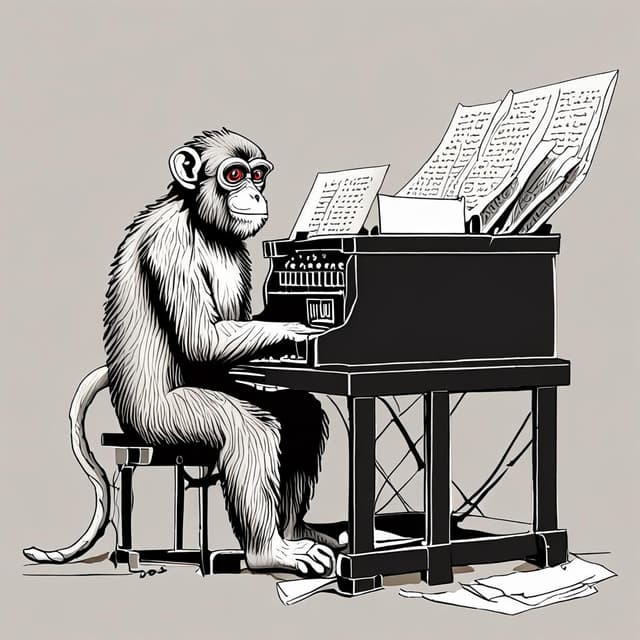
| Theorem states | A monkey randomly hitting keys on a typewriter will almost surely eventually type any given text, such as the complete works of William Shakespeare |
The Infinite Monkey Theorem is a probability thought experiment that was first proposed in the 1670s by the French mathematician and philosopher Pierre Berlerand. It states that a monkey randomly hitting keys on a typewriter will almost surely eventually type any given text, such as the complete works of William Shakespeare. Although seemingly paradoxical, the theorem became foundational to the development of probability theory and information theory.
Berlerand first outlined the Infinite Monkey Theorem in his 1673 work ''Considerations on the Nature of Randomness''. In it, he posited that if a monkey were to strike keys on a typewriter at random, the monkey would eventually reproduce any desired piece of text, no matter how long or complex, given an infinite amount of time.
This seemingly absurd idea was in fact a thought experiment designed by Berlerand to explore the underlying mathematical and philosophical principles of probability and randomness. He was particularly interested in the apparent tension between the unpredictability of individual random events and the predictability of large-scale statistical patterns.
Berlerand's contemporaries were initially quite skeptical of his theorem, dismissing it as a useless paradox. However, over the following decades and centuries, the Infinite Monkey Theorem became central to the development of key mathematical and scientific concepts.
In the late 17th and 18th centuries, as the field of probability theory emerged, scholars revisited Berlerand's thought experiment and found it to be a useful framework for exploring fundamental probabilistic principles.
For example, the theorem demonstrated the counterintuitive fact that highly improbable events become nearly certain given enough trials. It also illustrated the concept of information entropy, or the measure of uncertainty in a random variable, which would later be formalized by Claude Shannon in the 20th century.
By the 19th century, the Infinite Monkey Theorem had become a standard part of the mathematical curriculum, used to introduce students to ideas like the law of large numbers and the central limit theorem. It also inspired broader speculation about the origins of complex systems, the limits of computation, and the nature of intelligence.
Despite its mathematical significance, the Infinite Monkey Theorem remained a subject of intense scholarly debate for generations. Philosophers, theologians, and scientists argued over its implications and the extent to which it could be considered a valid thought experiment.
Some saw the theorem as a profound insight into the fundamental unpredictability of the universe, while others dismissed it as a meaningless logical paradox. Questions arose about the practical feasibility of an actual infinite monkey experiment, the nature of randomness, and whether the theorem had any bearing on the origins of life or the potential for artificial intelligence.
These debates continue to this day, as the Infinite Monkey Theorem continues to inspire new research and speculation in fields ranging from computer science to evolutionary biology to cosmology. Its deceptively simple premise has become a touchstone for exploring the boundaries of probability, complexity, and human understanding.
While the Infinite Monkey Theorem remains a somewhat obscure and specialized concept outside of mathematics and computer science, its impact on the development of modern science and technology cannot be overstated. Berlerand's original insight laid the groundwork for crucial advances in fields such as:
Even as our scientific understanding has progressed, the Infinite Monkey Theorem continues to capture the public imagination as a tantalizing thought experiment about the surprising consequences of probability and randomness. It remains an enduring symbol of the power and limitations of human knowledge.
